
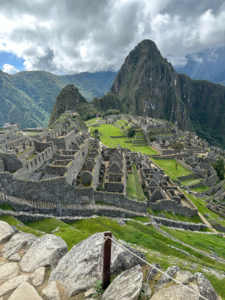
Machu Picchu is a 15th century Inca citadel located in the Andes mountain range of Peru. Often known as the “Lost City of the Incas”, Machu Picchu is the best-known symbol of the Inca civilization and perhaps the most important archaeological site in South America. Interested in the wider Machu Picchu region, some other settlements remain unexcavated, and investigations have revealed more than 100 pre-Hispanic sites in the immediate area
(Masini et al., 2023). Machu Picchu is a UNESCO World Heritage Site, and since 1981 it has also been a Historical Sanctuary of Peru. Built when the Inca Empire was at its peak, Machu Picchu remains a mystery to this day. The site is strategically located on the top of a 600-meter mountain and is made up of terraces and structures built with a stonemasonry technique known as ashlar masonry. Each stone is exactly shaped and held together without mortar. Additionally, the flatter sides of the stone slopes are all aligned towards a specific direction, making the terrain drain naturally.
(S. Mears, 2019). Each structure was designed with an understanding of its purpose, and there are even sophisticated water drainage channels made of stones. However, scholars are baffled as to why and how Machu Picchu was built. It differs from other Inca civilizations, which were built lower down, since Machu Picchu is located about 2,400 meters above sea level. Furthermore, there are no local quarries, and all the stones came from the other side of the valley and were carried
As if from a movie
Knowing the people who stayed in time, the colors, the clothes, the gastronomy, the train ride makes you live your own history being the protagonist of the movie of your life, hand in hand with the history of the Incas in our times.
I have lived an incredible experience, like in a movie, every time I remember it I get a smile and happiness.
do not hesitate to introduce yourself in the history of the Incas who had a closeness and knowledge of nature living together in harmony.
References:
Masini, N., Romano, G., Sieczkowska, D., Capozzoli, L., Spizzichino, D., Gabellone, F., Bastante, J., Scavone, M., Sileo, M., Abate, N., Margottini, C., & Lasaponara, R., 2023. Non invasive subsurface imaging to investigate the site evolution of Machu Picchu. ncbi.nlm.nih.gov
S. Mears, J., 2019. Machu Picchu from an Engineeru27s Perspective. [PDF]